

Hilmi al-A‘raj
The Karameh Crossing, also known as the “Jordan Bridge,” is supposed to be a lifeline for Palestinians. In reality, however, it has become a gateway of daily humiliation and a harsh test of human dignity. It is no longer merely a crossing point between two banks, but rather an open space of prolonged waiting, degrading searches, and continuous psychological pressure, imposed through limited working hours and strict procedures that make passage an exhausting and often nearly impossible experience.
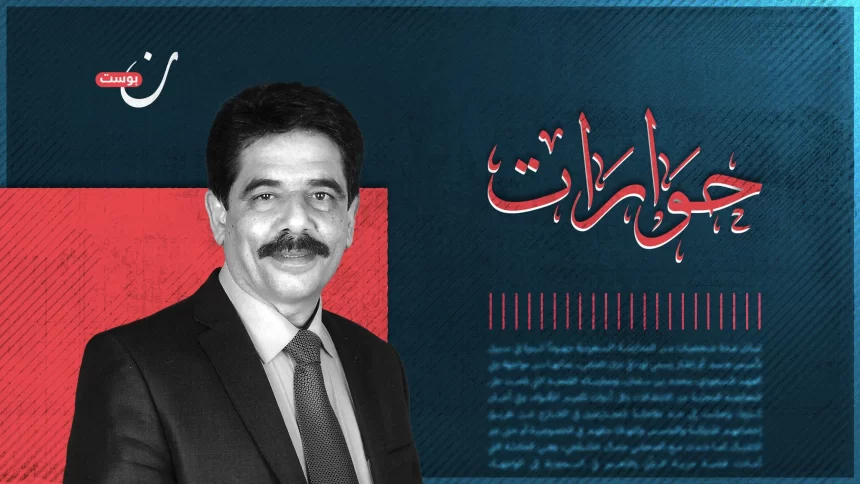
In this context, Noon Post conducted a special interview with Hilmi al-A‘raj, Director of the Center for the Defense of Liberties, to unpack the tragic reality of the Karameh Crossing. According to his description, the bridge is no longer an incidental security or administrative procedure, but a systematic tool used by the occupation to humiliate Palestinians and suffocate their movement and fundamental rights—while the world continues to observe from a distance, without taking any meaningful action toward accountability or the protection of human dignity.
As al-A‘raj explains, the daily suffering at the crossing reveals that what is happening goes far beyond administrative confusion or temporary restrictions, reaching the level of a deliberate policy aimed at breaking the Palestinian individual and turning them into a hostage to every decision issued by the occupation system.
How can the continued Palestinian suffering at the Jordan Bridge (Karameh Crossing) be explained, despite its long-standing status as a civilian crossing?
This ongoing suffering, which has persisted for decades, can be explained by the existence of the occupation and its practices and policies aimed at imposing internationally prohibited collective punishment on the Palestinian people and violating the dignity of all Palestinians—women and men, children, the elderly, and the sick. Travelers are subjected to humiliating searches, including strip searches, inhumane treatment, and prolonged detention at the crossing under the pretext of security procedures.
Travel through the Karameh Crossing has long been—and remains—a journey of torment, suffering, and degradation of human dignity. In recent times, especially after October 7, this suffering has escalated significantly. The occupation has deliberately reduced working hours and days for extended periods, rendering the crossing incapable of accommodating the number of Palestinian travelers, despite the fact that it is their only gateway to the outside world.
Operating the crossing for limited hours under strict and complex security procedures reflects a deliberate intent to humiliate Palestinians. The occupation justifies these policies by claiming full sovereignty over the crossing, while denying any sovereignty to the Palestinian National Authority—an attempt not only to deny Palestinian dignity, but to deny the existence of the Palestinian people altogether.
All of this occurs in full view of the international community. Diplomatic missions are fully aware of what is happening and see its details clearly, yet they remain inactive, further deepening the suffering. This hardship intensifies during holidays, religious occasions, and travel seasons such as Hajj and Umrah, annual holidays, Christmas, school breaks, and public vacations. Thousands of travelers crowd the crossing, unable to travel, forced to wait for days on end, day and night.
This situation persists because the occupation continues to enforce its decision to impose collective punishment to the maximum extent possible—despite having full control and the ability to open the crossing 24 hours a day, seven days a week, like all other crossings.
To what extent is the Jordan Bridge used as a tool of collective punishment rather than a security measure?
In reality, the Karameh Crossing is used as a tool of collective punishment par excellence, not merely as a security procedure. The suffering imposed constitutes a clear form of economic exhaustion for Palestinian citizens. Travel costs are extremely high: the citizen leaves their homeland under occupation, pays exorbitant fees and taxes, and if traveling with a family, the financial burden becomes doubled and crushing.
Additionally, there is the humiliation of human dignity through complex security procedures, degrading searches, harsh treatment, and hours-long waiting in both summer heat and winter cold. Overcrowding exacerbates the suffering, leaving serious psychological and health impacts on travelers. Their nerves are drained, their time wasted, their money stolen, and their daily hardship multiplied.
Moreover, the occupation controls every detail of travel. Many citizens have prior flight reservations, work commitments, medical appointments, or religious travel arrangements, yet all are jeopardized due to their inability to reach the airport on time as a result of reduced operating hours at the crossing.
This problem becomes particularly severe on Fridays and Saturdays, when working hours are minimized. Palestinians are forced to incur additional expenses—booking hotels in Amman for one or two nights instead of proceeding directly to the airport. A traveler departing on a Thursday, for example, may have to book accommodation for Friday and Saturday nights just to catch a Sunday flight, creating immense financial strain.
As a result, the citizen remains in a constant state of anxiety: Will I be able to cross? Will I be allowed to travel? Will my journey be disrupted? Added to this is the occupation’s policy of “security bans,” another form of collective punishment imposed without explanation or legal justification.
From a legal perspective, how should practices of return and travel bans without clear reasons be assessed?
Legally, the practice of returning travelers and banning them from travel without providing clear reasons constitutes a blatant violation of the Universal Declaration of Human Rights and the International Covenant on Civil and Political Rights—particularly the right to freedom of movement and travel. This violation extends beyond the right itself and infringes upon numerous interconnected civil rights.
For Palestinians living under occupation, travel is not a luxury. It is often tied to work, education, or medical treatment—especially given restrictions on access to occupied Palestine and Jerusalem. Many Palestinians are denied medical treatment in Jerusalem or in hospitals such as Hadassah inside the occupied territory, only to be simultaneously barred from traveling abroad for treatment, directly endangering their right to health and life.
The right to work is sacred, enshrined in constitutions and international conventions. Every human being has the right to life, work, freedom, and movement. When these rights are confiscated through arbitrary administrative decisions—without judicial rulings or legal justification—the damage extends to families and society as a whole.
A sick person is denied treatment, a student is denied education, a graduate is denied employment, and a believer is denied the right to perform Umrah or Hajj. The right to family life is also violated, as Palestinians are prevented from visiting family members living in the United States, Europe, the Gulf, Arab countries, or Jordan.
Thus, the issue goes far beyond an individual travel ban. It inflicts widespread harm on families, society, and the economy, and causes deep psychological and moral injury—amounting to collective punishment prohibited under international human rights law.
What are the most serious violations faced by Palestinian travelers at the Jordan Bridge from a legal and human rights perspective?
According to monitoring by the Hurryyat Center, the most serious violation is the systematic and deliberate denial of the right to freedom of movement and travel—a right explicitly guaranteed under international humanitarian law, the Universal Declaration of Human Rights, and the International Covenant on Civil and Political Rights.
When this right is violated so comprehensively, it demonstrates premeditated breaches of international law by the occupation, opening the door to violations of numerous other rights: work, worship, education, healthcare, and family life.
Furthermore, the occupation directly assaults human dignity through deliberate humiliation and degrading treatment at the crossing. When such practices are intentional and carried out by an official authority, they legally rise to the level of psychological and physical torture.
Keeping patients, pregnant women, children, and the elderly waiting for hours in harsh conditions under the scorching sun constitutes inhumane and degrading treatment. When such actions are officially sanctioned, they fall under the definition of torture as outlined in the Convention Against Torture.
Final message to the international community
Assume your legal, political, and moral responsibilities toward the suffering of the Palestinian people under occupation. Respect their right to self-determination, the establishment of their state, and the end of the occupation in accordance with international law and United Nations resolutions.
The international community must move beyond statements of condemnation and toward real accountability. The daily humiliation at the Karameh Crossing—and the collective punishment imposed there—demands immediate and serious action.